Industry
Poorr in Personal Finance
One of 10 directions Poorr could take — a possibility explored in full, not a commitment. The buyer picks one, picks several, or holds the whole menu as optionality.
Personal finance is the category Poorr was built for. Most fintech brands in the space are organized around the assumption that the user is on a wealth-accumulation trajectory — index-fund investing, retirement projections, a house down payment in five years. That assumption describes a minority of adult American households. The majority are managing variable pay, credit-card balances, medical debt, childcare costs, and rent that resets upward every lease. Their financial lives are operationally complex and emotionally taxing, and they have almost no serious consumer brand speaking to them about it. Poorr's personal-finance product is designed for that majority. It is an application and a content property organized around the operational work of household money: categorized spending history, bill-due calendars, irregular-income smoothing, emergency-fund progress, and debt paydown tracking. What the product omits is also what makes it distinct. There are no stock ticker widgets. There are no crypto primers. There is no gamified streak. The interface assumes the user is a competent adult who has been failed by playful money apps and is looking for something more grown-up. The business model is subscription — roughly in the ballpark of established budgeting apps like YNAB and Monarch — with an honest free tier. Subscription beats advertising for this audience because ad-supported personal-finance products develop an unavoidable conflict of interest: the app's incentive is to route the user toward products that pay referral commissions, which are almost never the products the user should use. Poorr's revenue comes from the user; the app's advice does not have to be bent. The editorial arm is the brand's defensive moat. A steady cadence of long-form articles — debt math explained clearly, household budget frameworks that account for gig income, practical guides to benefits navigation — gives the audience a reason to trust the app before they download it. The writing is the acquisition channel; the app is what converts the trust into a retained user. The two pieces work together. Neither works alone.
Scenarios
Three plausible products or platforms within this vertical. Pick the angle that fits — the rest reveal once you commit. Or click "show all" if you want the static grid back.
Which spark sounds most like you?
Scenario · 01 of 3
Weekly Budget Companion
A Poorr subscription tier that pairs the app with a mailed monthly paperback workbook — Lora-typeset, prompt-based, usable at the kitchen table with a pen. Functions as the tactile counterpart to the digital spending log, priced as an add-on that covers printing, shipping, and a small margin.
Irregular-Income Module
A specific app module for 1099 workers, hospitality staff, and commissioned sellers that averages pay across rolling windows and recommends week-by-week transfers from a smoothing buffer. Solves the feature most consumer fintechs ignore because their user base is assumed to be W-2 and salaried.
Couples Budget Sessions
A monthly guided video session for two-person households where a Poorr editor walks partners through a shared-money template. Priced as a separate subscription; reaches a demographic that mass-market budget apps reliably fail.
Product Concepts
Named, described, and visualized so the brand feels alive. Nothing here is a promise — use them, rename them, replace them, or leave them on the site as ambient proof that Poorr has legs.
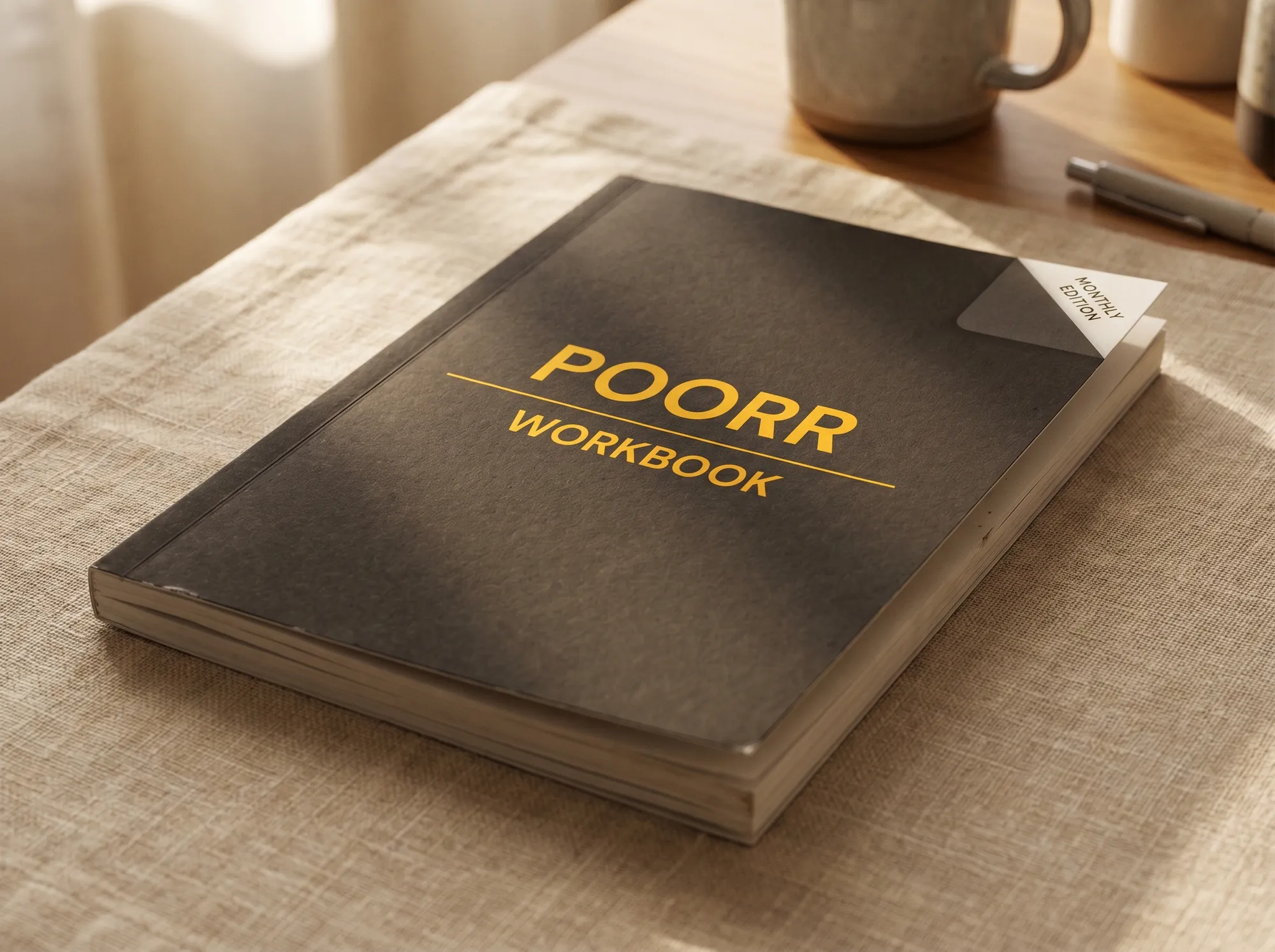
Print subscription
Poorr Workbook
A 48-page paperback budget workbook mailed monthly to subscribers, Lora-typeset with DM Sans headers. Covers categorization, bill calendar, irregular-income tracking, and a reflective end-of-month page.
$18–$24
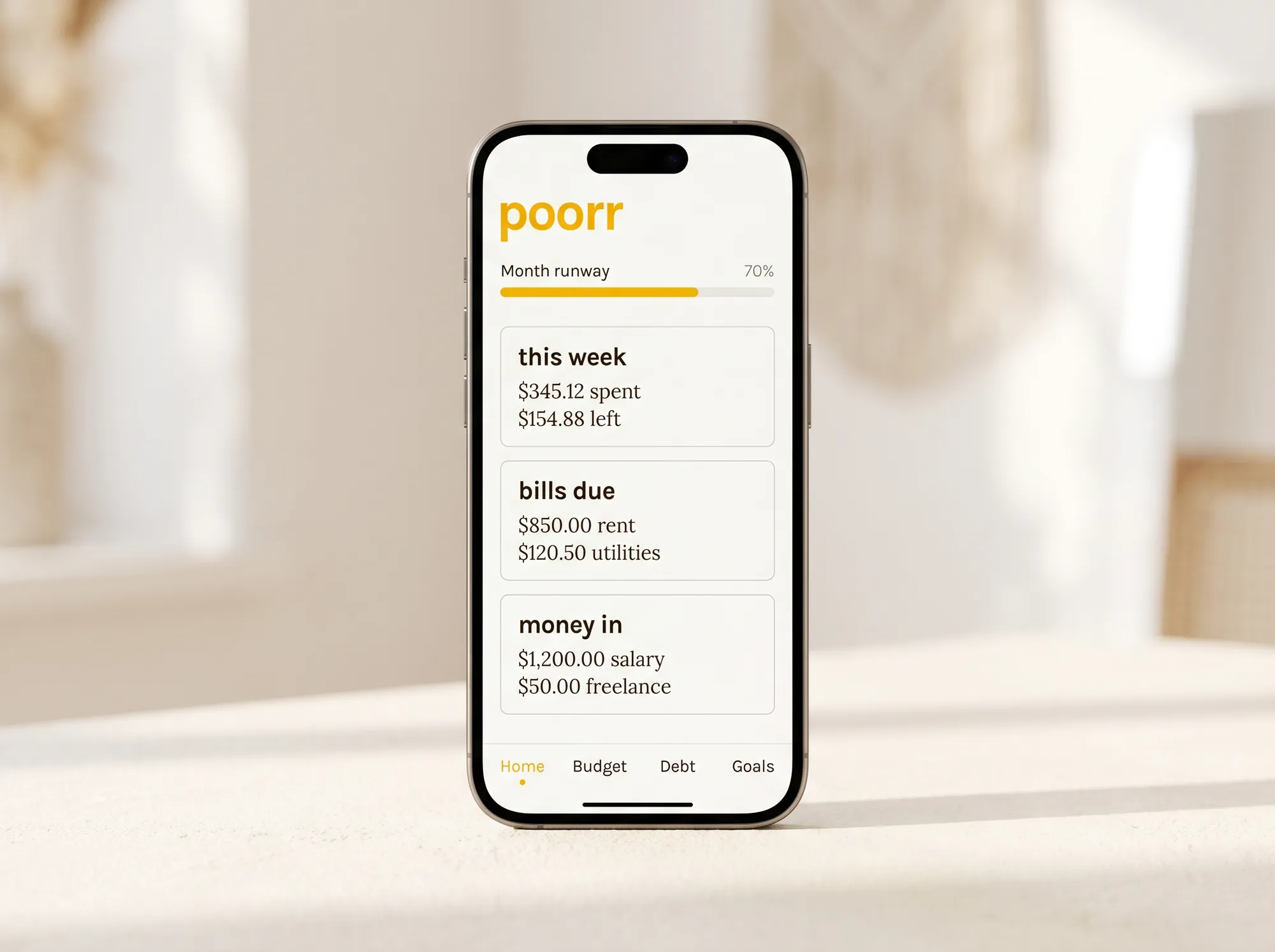
Mobile app
Poorr App
The core iOS and Android app with account aggregation, spending categorization, a bill calendar, and a debt tracker. Free tier covers one checking account and two credit cards; paid tier unlocks the irregular-income module and the couples workflow.
$0–$14/mo

Service
Poorr Couples
A monthly fifty-minute guided video session for two-person households, led by a Poorr editor, walking partners through a shared-budget template and an annual household-money calendar.
$39/mo
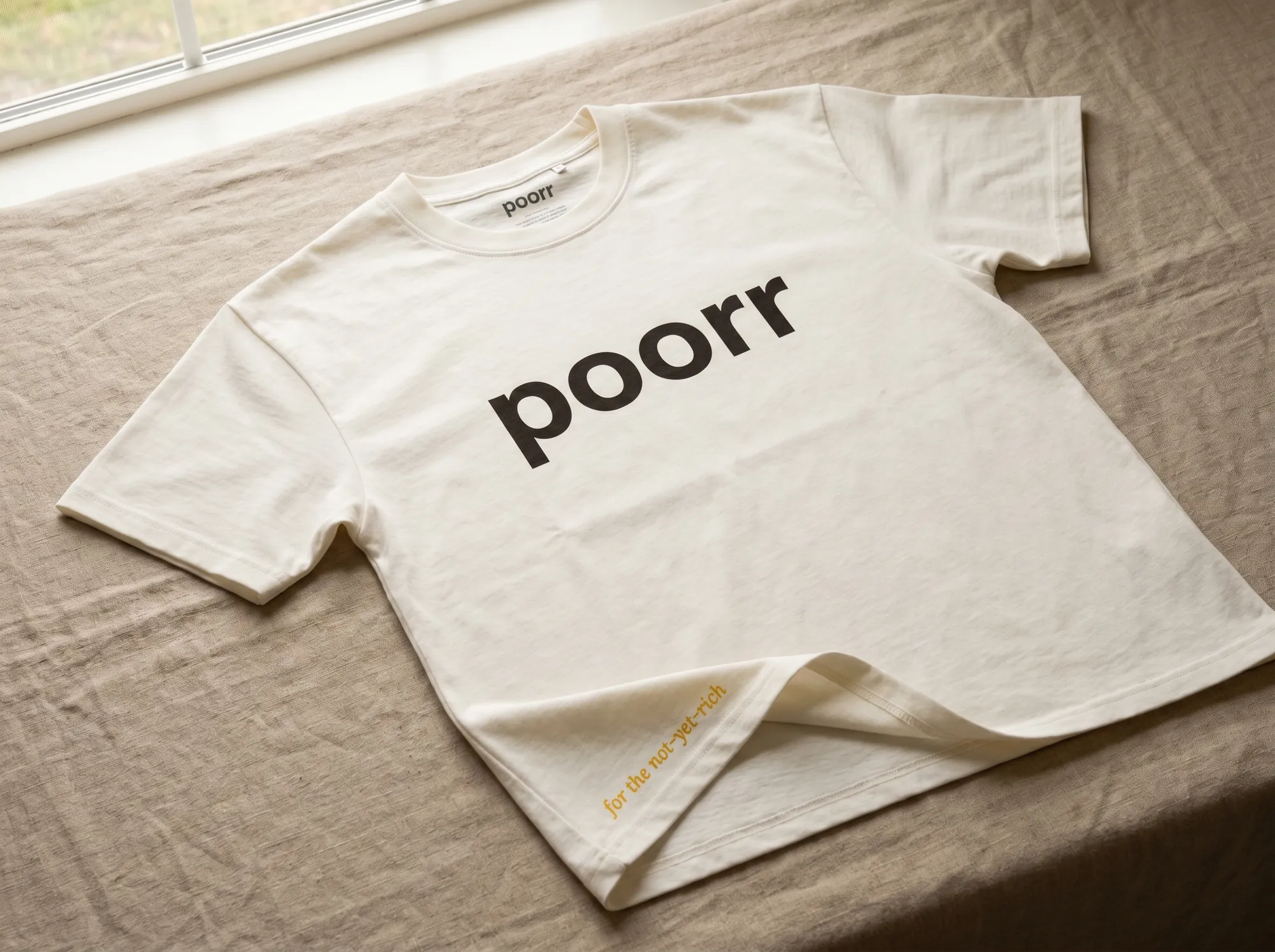
Apparel
Poorr Tee
A heavyweight warm off-white cotton tee printed with the wordmark in warm charcoal and a small Lora italic line at the hem reading 'for the not-yet-rich.' Plain B2C apparel.
$32
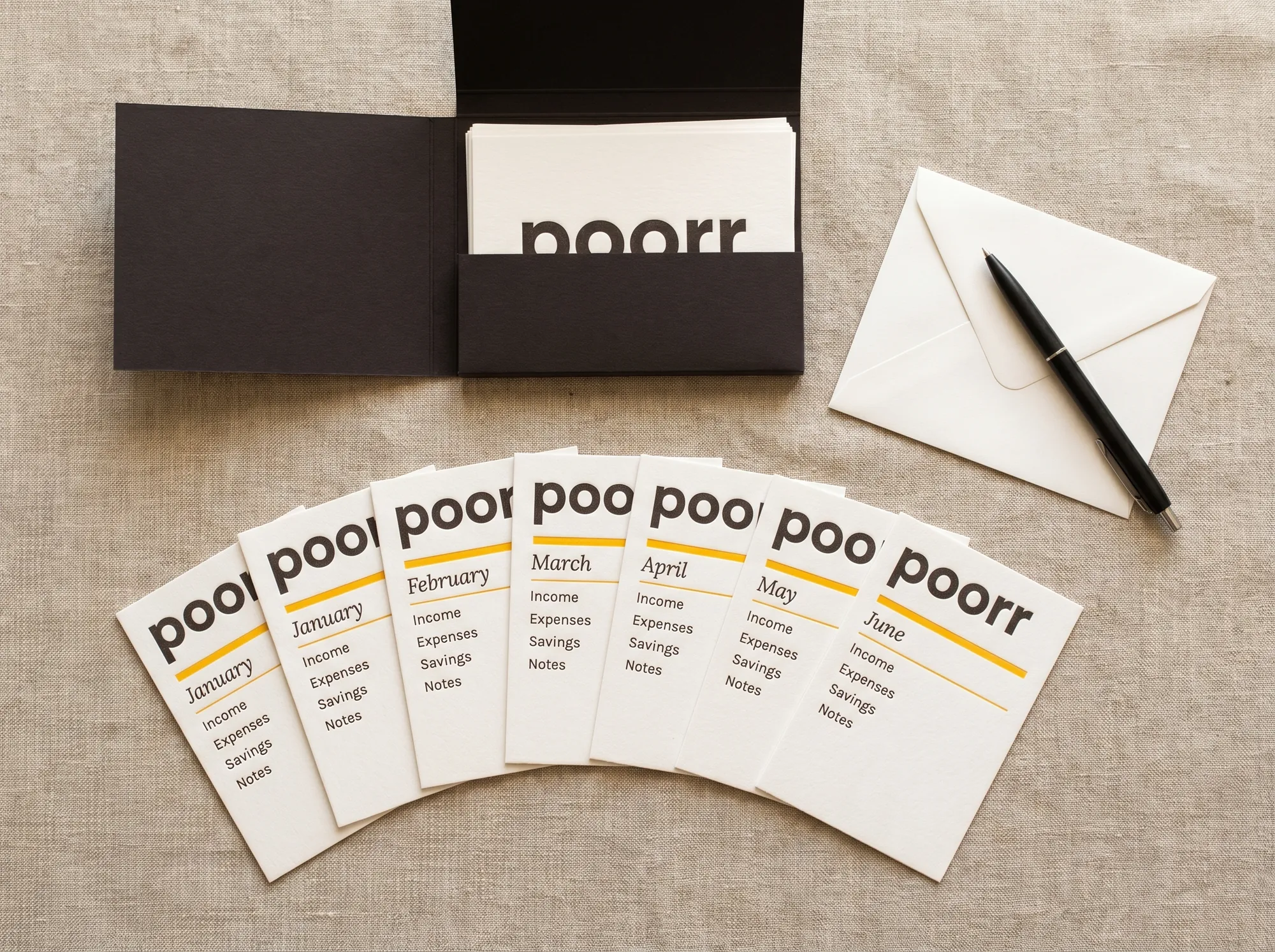
Stationery
Poorr Money Card Set
A flat case of fifty letterpress monthly-budget cards used by readers — wordmark, month label, four envelope categories, single citrus-yellow rule.
$24 per set
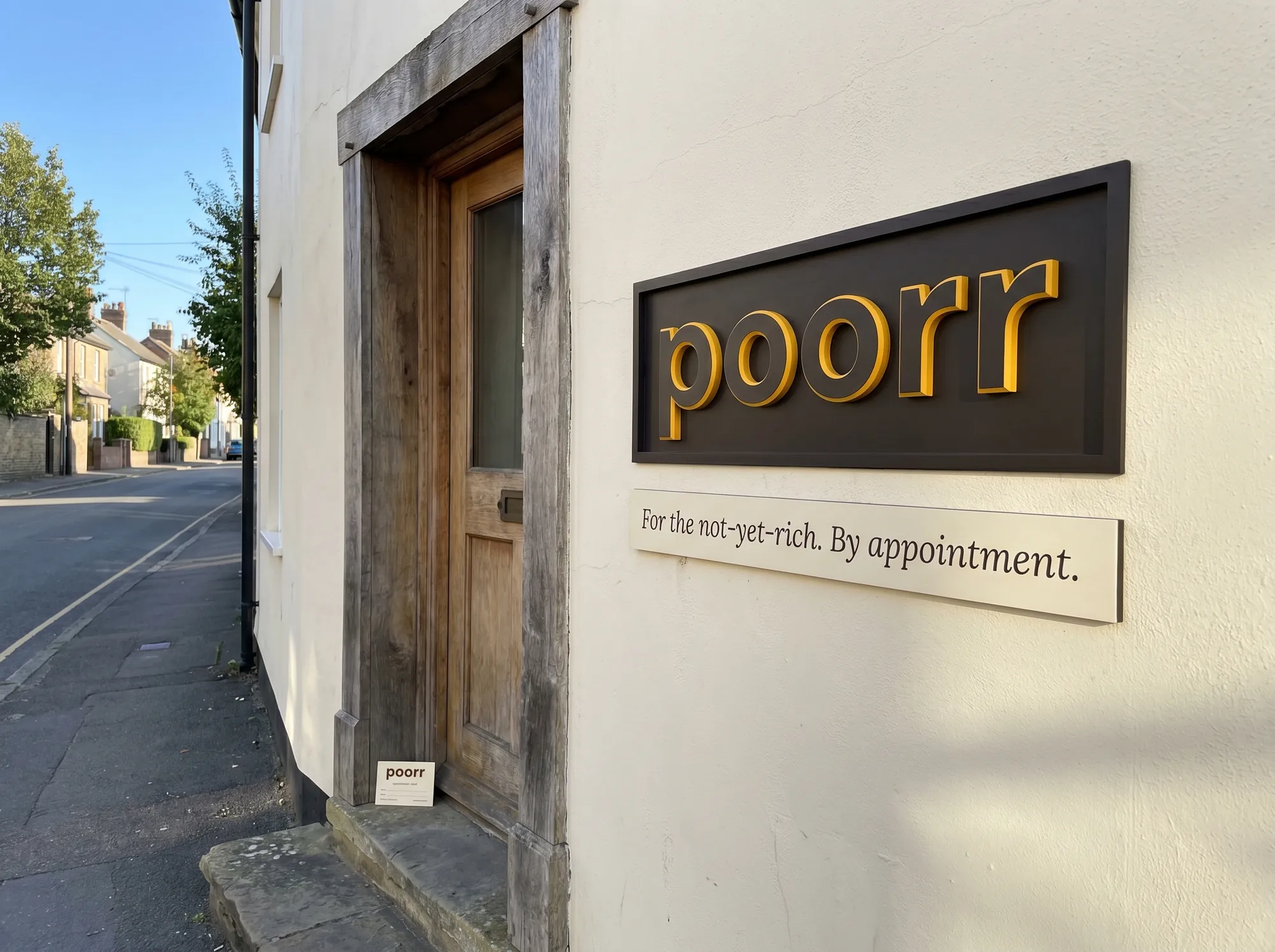
Signage
Poorr Office Plate
The painted-MDF wordmark plate that hangs at the small Poorr workshop space — working public signage at the storefront where in-person sessions are held.
Walk-in
Radio Ad Script
Thirty seconds of Poorr in this vertical. Visitors often play it twice — and every listen makes the brand a little more familiar in their head. That familiarity belongs to the owner.
“You know that feeling when you check your balance on a Tuesday and it is already the wrong number. Poorr is for that feeling — a personal finance app built for people who are not rich. Budget, pay down debt, sleep better. Poorr dot com.”
For the investor
Personal Finance is one of 10 directions.
Every Poorr industry is an application of the same one-word thesis: the not-yet-rich audience is enormous, under-branded, and ready for a consumer brand that treats them as adults. You do not have to pick one vertical to own the domain. The ten industries in this package are a menu; the audience is the asset. While you choose, the editorial keeps ranking and the brand keeps compounding.