Industry
Poorr in Childcare Affordability
One of 10 directions Poorr could take — a possibility explored in full, not a commitment. The buyer picks one, picks several, or holds the whole menu as optionality.
Childcare is the budget line that forces the household calendar. A full-time infant room slot in a typical U.S. metro runs roughly fifteen thousand dollars a year on average and meaningfully more in higher-cost cities — which for a median-earning household absorbs a substantial share of post-tax income. Care.com and similar marketplaces are optimized for the logistics of finding a provider; none of them are organized around the affordability question that determines whether a second parent can stay in the workforce at all. Poorr's childcare surface is not a provider directory. It is a calculator, an editorial library, and a navigation tool for the programs that meaningfully reduce cost: state-level childcare subsidies, employer-sponsored dependent-care accounts, the child and dependent care tax credit, head-start enrollment, and the small set of states that have begun experimenting with universal pre-K. The goal is to produce, for a specific household with specific children in a specific zip code, the real out-of-pocket number after every subsidy the household qualifies for has been claimed. The editorial covers the adjacent questions that show up once the cost picture is clear. When does it make sense for the second earner to step out of the workforce, and when does it not. How to evaluate a nanny-share arrangement versus a center. How to use a dependent-care FSA without losing money on the use-it-or-lose-it rules. How to talk to a grandparent about contributing, if that is an option. The writing is patient, voice-aligned, and assumes the reader is making a serious household decision, not browsing for inspiration. Partnerships are again nonprofit and public. State childcare-resource-and-referral agencies, Head Start grantees, and the employer-benefit navigators who actually help families claim what they are entitled to get editorial coverage because those are the institutions that move the household's real number. Poorr is the editorial front door that points the reader toward them.
Scenarios
Three plausible products or platforms within this vertical. Pick the angle that fits — the rest reveal once you commit. Or click "show all" if you want the static grid back.
Which spark sounds most like you?
Scenario · 01 of 3
True-Cost Childcare Calculator
A calculator that takes household income, number and ages of children, state of residence, and employer benefits, and returns the real annual out-of-pocket childcare cost after every subsidy, tax credit, and dependent-care account the household qualifies for.
Second-Earner Workforce Model
A worksheet and editorial piece that helps a household model whether the second earner's income meaningfully exceeds the childcare and commuting cost of staying in the workforce. Honest about the long-term Social Security and retirement implications of stepping out.
Dependent-Care FSA Coach
A guided setup for employer-sponsored dependent-care FSAs — enrollment timing, reimbursement mechanics, how to avoid forfeiting unused funds. Integrated with the Poorr app so the user sees their FSA balance alongside their other household accounts.
Product Concepts
Named, described, and visualized so the brand feels alive. Nothing here is a promise — use them, rename them, replace them, or leave them on the site as ambient proof that Poorr has legs.
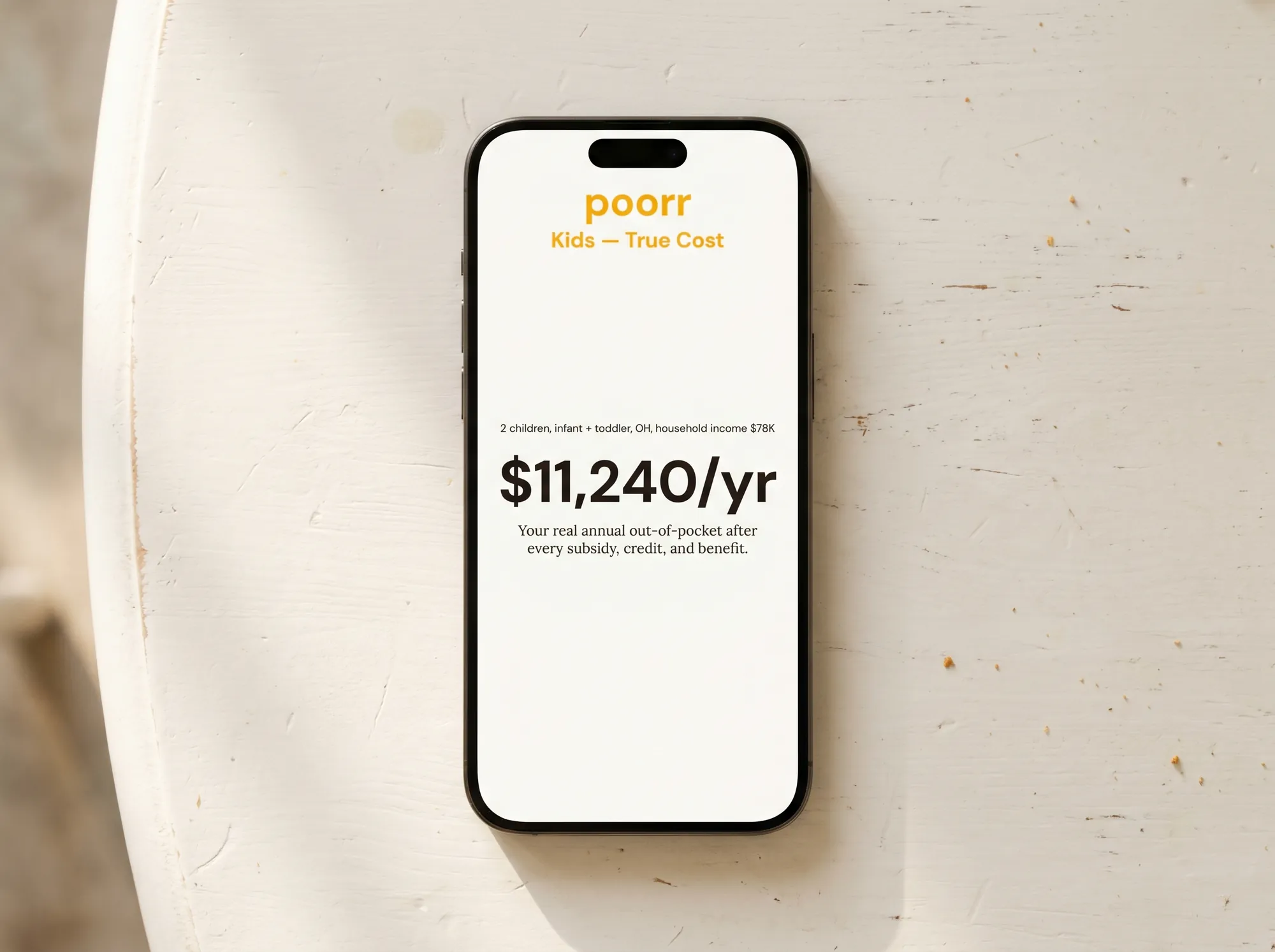
Mobile app module
Poorr Kids
A childcare-affordability module inside the Poorr app covering the true-cost calculator, the FSA coach, and the state-subsidy navigator. Pairs with the household budget so the real childcare number flows into the rest of the household's cash-flow math.
Included with Poorr app
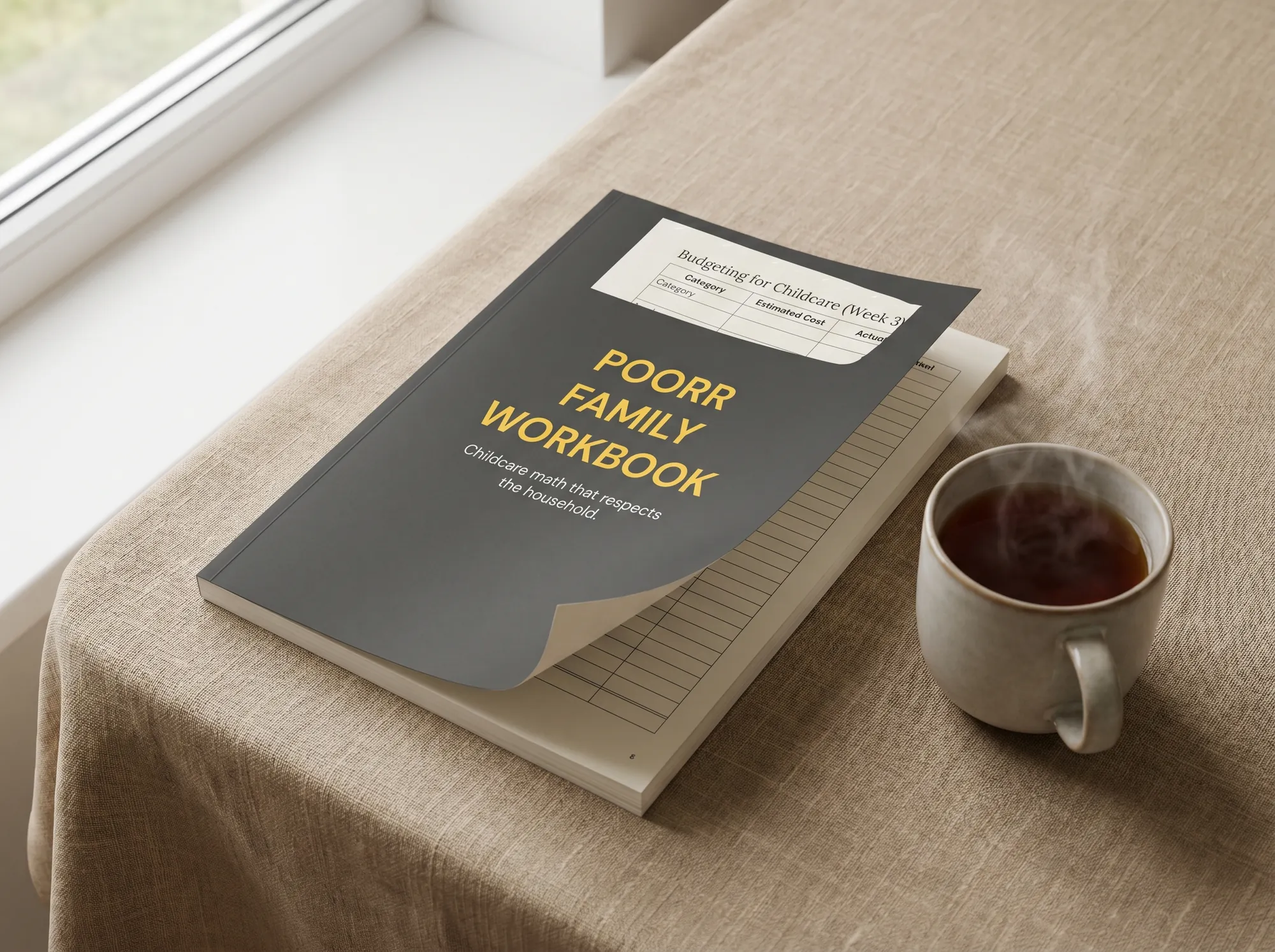
Printed workbook
Poorr Family Workbook
A 64-page printed workbook guiding a household through the childcare decision — true-cost worksheet, second-earner model, provider-evaluation checklist, and end-of-year tax-credit reconciliation. Lora-typeset, paperback.
$26
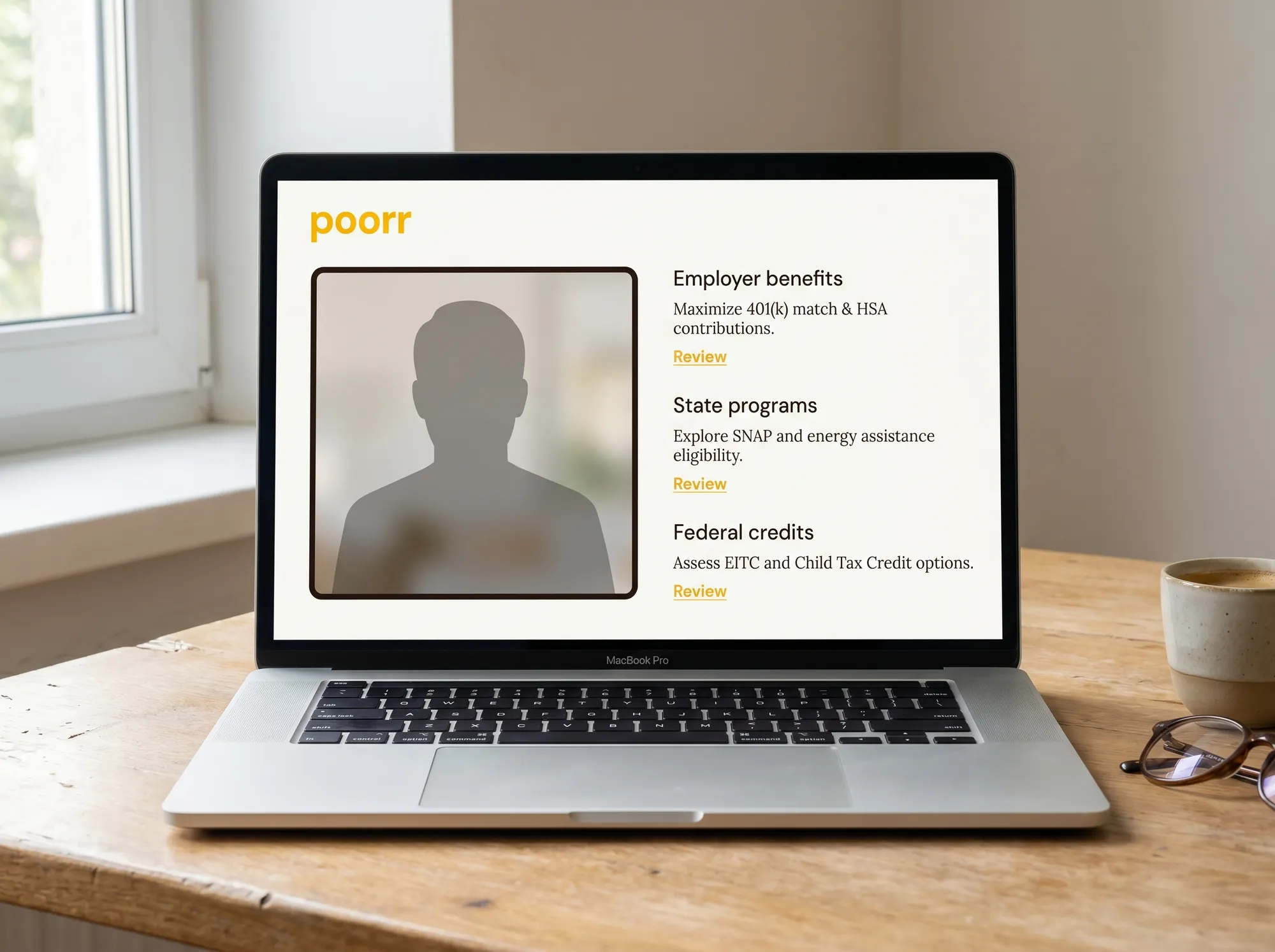
Service
Poorr Family Advisor Session
A one-hour video session with a Poorr-vetted benefits navigator who walks the household through its employer offerings, state programs, and federal credits, and produces a written action list.
$85

Apparel
Poorr Family Tee
A heavyweight cream cotton tee with the wordmark in warm charcoal and a small Lora italic line at the hem reading 'true cost reader.' For Kids module subscribers.
$32
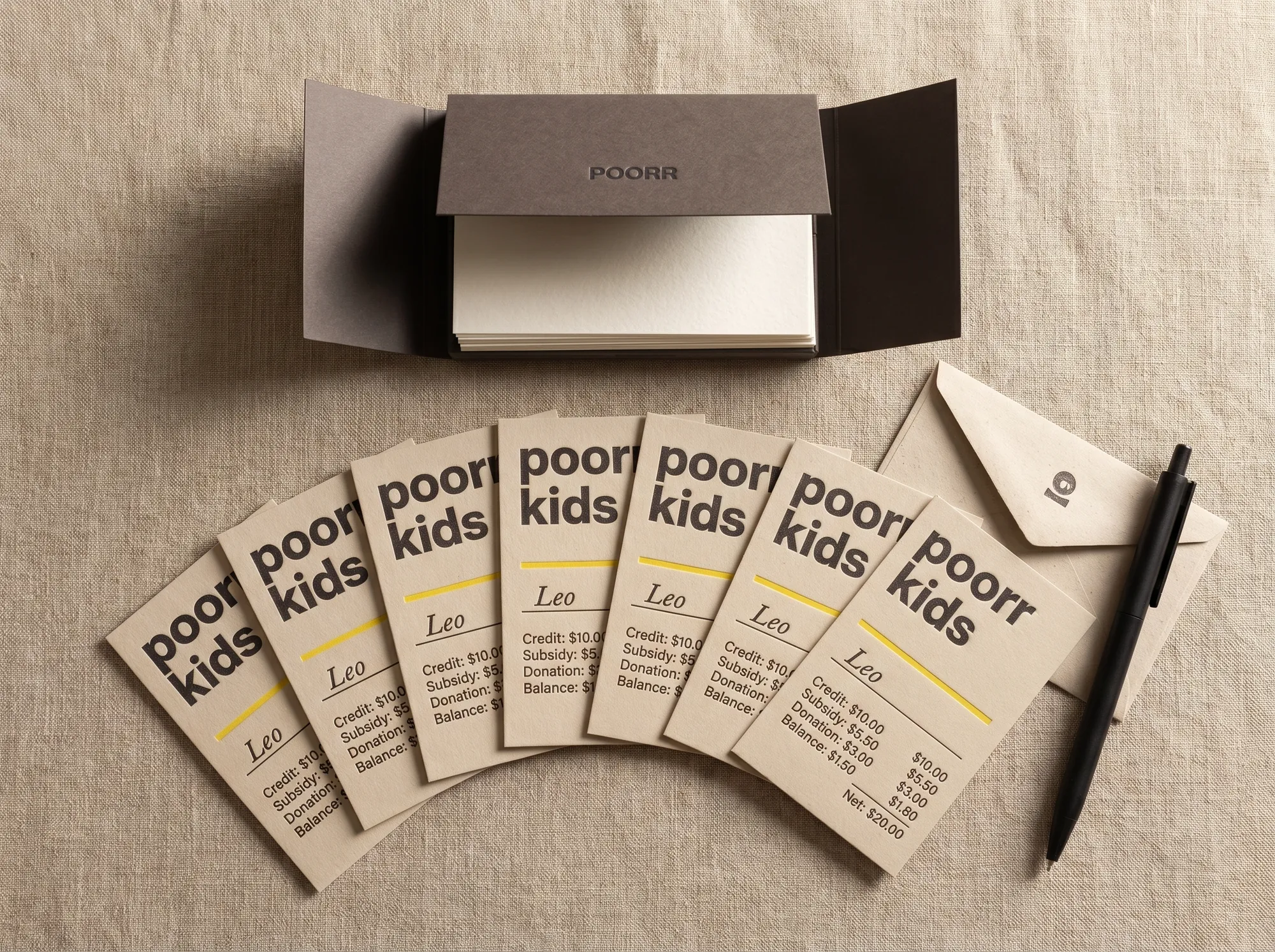
Stationery
Poorr Family Card Set
A flat case of fifty letterpress true-cost cards — wordmark, child-name field, four credit/subsidy rows, dollar net field, citrus rule.
$24 per set

Signage
Poorr Family Office Plate
The painted-MDF wordmark plate at the small Poorr workshop space during Family office hours — working public signage marking the family-advisor window.
Internal use
Radio Ad Script
Thirty seconds of Poorr in this vertical. Visitors often play it twice — and every listen makes the brand a little more familiar in their head. That familiarity belongs to the owner.
“For the not-yet-rich with kids. That is who Poorr is for. The true cost of childcare after every subsidy, every tax credit, every benefit your employer buries in an open-enrollment PDF. Poorr dot com.”
For the investor
Childcare Affordability is one of 10 directions.
Every Poorr industry is an application of the same one-word thesis: the not-yet-rich audience is enormous, under-branded, and ready for a consumer brand that treats them as adults. You do not have to pick one vertical to own the domain. The ten industries in this package are a menu; the audience is the asset. While you choose, the editorial keeps ranking and the brand keeps compounding.